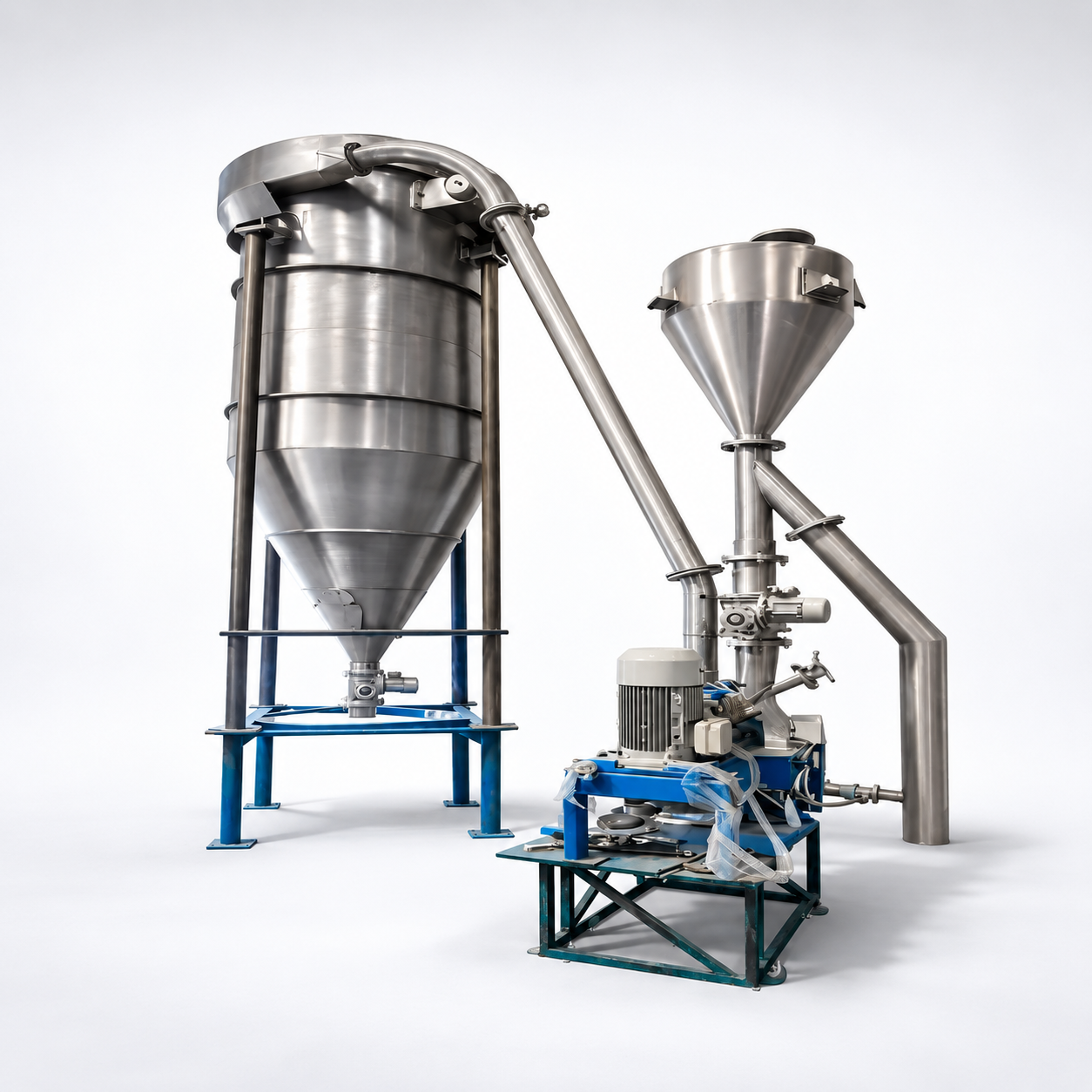


S k Engineers is leading Spice Grinding Machine Manufacturers, Suppliers, Dealers and Exporters in India. A spice grinding machine is an advanced food processing solution designed to grind whole spices into fine, uniform, and high-quality powder while preserving their natural aroma, color, flavor, and essential oils. These machines are widely used in spice processing industries, food manufacturing companies, masala production units, commercial kitchens, and export-oriented food businesses. Modern spice grinding systems are equipped with automatic feeding units, stainless steel grinding chambers, cyclone separators, air classifiers, sieving systems, and dust collection units to ensure hygienic and efficient production.
Whether processing turmeric, chili, coriander, cumin, pepper, cardamom, or mixed spices, a modern spice grinding machine provides consistent particle size, higher production capacity, and reduced product loss. Available in commercial and industrial capacities, these machines help manufacturers improve productivity while meeting food safety and quality standards.
A spice grinding machine is a specialized food processing machine used to convert whole or dried spices into fine powder through controlled grinding. The machine consists of feeding hoppers, grinding chambers, pulverizers, cyclone separators, vibrating sieves, dust collectors, and automatic discharge systems that work together to produce premium-quality spice powder.
Modern spice grinding machines are manufactured using food-grade stainless steel and incorporate low-heat grinding technology to preserve the natural oils, aroma, color, and nutritional properties of spices. These machines are suitable for processing individual spices as well as blended masala powders, making them an ideal solution for commercial food processing and industrial spice manufacturing. For controlled powder discharge and transfer in an integrated processing line, an industrial rotary airlock valve may also be used where appropriate.
Step 1: Raw Material Feeding
Step 2: Material Conveying
Step 3: Grinding Process
Step 4: Sieving and Classification
Step 5: Powder Collection and Packaging
As Spice Grinding Machine Manufacturers in India, our machine types are designed to meet different application requirements and industry standards, including the following:
Spice grinding machines can incorporate features designed to support hygienic processing, reliable operation, and consistent powder quality. Actual features depend on the selected machine configuration.
| Feature | Description |
|---|---|
| Food-grade stainless steel construction | Food-grade stainless steel contact parts can support hygienic processing, corrosion resistance, and easier cleaning. |
| Low heat grinding technology | Grinding configuration and operating conditions can be selected to help limit heat generation and protect spice quality. |
| High grinding efficiency | Suitable grinding mechanisms can provide efficient processing and consistent powder output for the intended application. |
| Uniform particle size | Appropriate sieving and classification arrangements help achieve the required particle size. |
| Dust collection | Cyclone separators and dust collectors can help capture powder and reduce airborne particles. A pulse jet bag filter may be used where suitable for the system's dust-control requirements. |
| Energy-efficient performance | Motor and machine selection should match the material, required output, and operating conditions to support efficient operation. |
A properly selected spice grinding machine can support consistent processing, efficient material handling, and reliable powder production.
Spice grinding machines are used in different food and agricultural processing applications, depending on the raw material, required particle size, and production capacity.
S K Engineers supplies industrial processing equipment for spice grinding and related powder-handling applications. The appropriate machine depends on the type and condition of the spice, required fineness, production capacity, and the desired level of automation. For integrated processing lines, related equipment may include pneumatic conveying systems, vacuum conveying systems, and suitable cyclone dust collection equipment. Discuss your material and production requirements to identify a suitable configuration.
A spice grinding machine is food-processing equipment used to grind whole or dried spices into powder. The required fineness depends on the machine configuration and application.
Depending on the machine design and material characteristics, spices such as turmeric, chilli, coriander, cumin, pepper, cardamom, cinnamon, cloves, fennel, and nutmeg may be processed. Suitability should be confirmed for the specific material.
Some industrial spice grinding systems are designed for continuous operation. Suitability depends on the selected equipment, material feed, target output, and operating requirements.
Controlling heat during grinding can help preserve the aroma, color, flavor, and essential oils of spices. The result depends on the material and operating conditions.
A cyclone separator uses centrifugal action to separate particles from an air stream and collect powder. Its performance depends on the particle characteristics and system design.
Food-contact construction requirements should be confirmed for the specific machine model. Ask the supplier to specify the materials used for product-contact parts and the cleaning requirements.